The phenomenon of the Ukrainian volunteer movement is unprecedented in its scope and outreach. Therefore, the first two stories relate to the activities of NGO “The Journalists Union “ALTERNATIVE”. They show how the organization, despite the occupation and close proximity to the front, continued to provide humanitarian aid and establish ties with other volunteer movements in the Kherson region.
The activities of Ukrainian volunteers were a ray of hope that Ukraine had not forgotten about Kherson, that everything would be fine and the city would be liberated. And the food from Ukrainian producers, which was distributed as humanitarian aid during the many months of occupation, was perceived by Kherson residents as both a miracle and something familiar, close, and from a peaceful life.
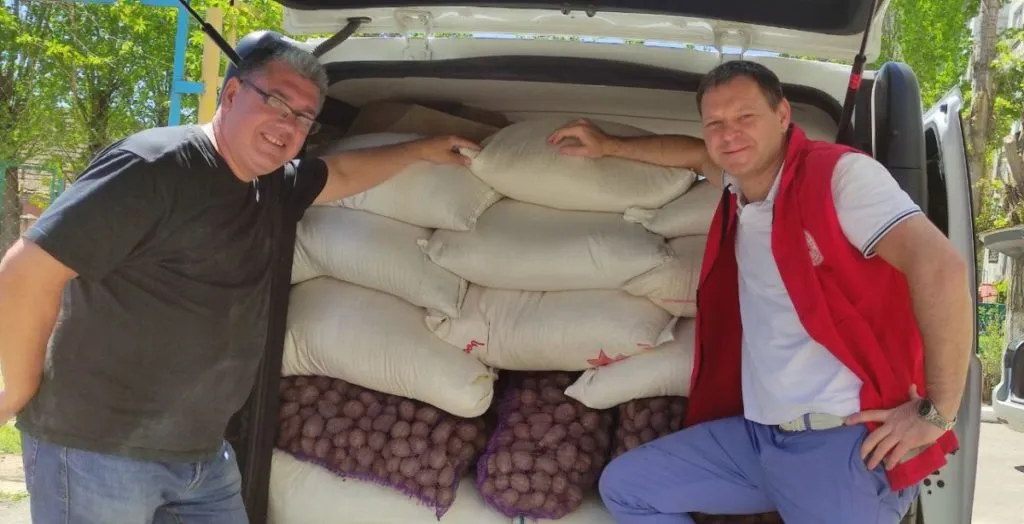
“On August 1, 2022, with the support of the Institute for Economic Research and Policy Consulting and the EU Delegation to Ukraine, we launched our project “Volunteering in the Occupation”. At that moment, Kherson had been in the occupation for exactly 5 months,” – says Volodymyr Kosiuk, Chairman of NGO “The Journalists Union “ALTERNATIVE”. – “August and September, the beginning of the project, were the worst for the civilian population. The russians had already settled in, brought in their officials and finally formed all the law enforcement (or rather repressive) bodies. Ukrainian activists and volunteers, ordinary Khersonians with a pro-Ukrainian position, were openly hunted down. Therefore, our team of volunteers had to work underground, taking all the risks, using passwords, safehouses and often changing their location.”
This project was specifically designed to support the team. People for whom volunteering became daily hard work, without holidays and weekends, with obligatory tasks, were paid an official salary with all Ukrainian taxes. And this was right under the occupiers’ noses.
The volunteer team of Kherson journalists was formed on the basis of the editorial team of Kherson Plus TV channel and started working on 13 March 2002. By that time the occupiers had already cut off the television from both the Ukrainian airwaves and cable networks in Kherson. It became extremely dangerous to appear on the streets with a video camera and microphone.
In March 2022, Kherson was completely cut off from all supplies, bread was no longer baked in the city, and not only the bakeries but almost all shop s and markets were closed. People wandered the streets all day in search of food, standing in long queues at the few supermarkets that were open, but often in vain. A humanitarian disaster loomed over the city.
The situation was even worse in the villages surrounding the regional centre, most of which were on the front line and with which there was virtually no communication. Kherson’s villages have long since ceased to be subsistence farms: villagers are used to buying bread, flour, pasta and oil in the shops. And in the spring, the food stored in the cellars for the winter was always running out. The famine has begun…
“We started small. We called our friends, the chefs of Kherson’s cafes and restaurants, and some of them agreed to share their stocks,” says Iryna Miezientseva, the team’s main coordinator and the author of the idea to create a volunteer movement of Kherson journalists. At the same time, we found out that the wholesale warehouses of several local farms in Kherson were full of pasta, flour and various cereals. They were ready to sell us the products at dumping prices, but of course not for free”.
A volunteer team of journalists from Kherson started collecting donations. Many Ukrainians from all over Ukraine and abroad responded to the first posts on social media. And a week later, the first lorry carrying 1.5 tonnes of food was sent to the village of Sofiivka in Stanislavska community.
Next were Stanislav, Komyshany and Bilozerka. International and Ukrainian charity organizations and NGOs took notice of the team’s activities. And while most of the volunteers were evacuated from Kherson in April-May 2022, the team of volunteer journalists expanded the geography of their assistance, joining journalists and cameramen from other media and ordinary volunteers.
By the beginning of the summer of 2022, the team covered 25 villages from five communities in the Kherson Region – Stanislavska, Bilozerska, Darivska, Muzykivska and Khersonska.
“The most difficult thing, apart from the daily threat of being taken to the occupiers’ “basement”, was to stay in the financial and tax field of Ukraine,” says Volodymyr Kosiuk, Chairman of NGO “The Journalists Union “ALTERNATIVE”. – “Russians had already opened their bank branches and shops in Kherson, forcing us to switch to rubles, and the city was flooded with Crimean and Krasnodar goods at exorbitant prices. But we only worked with the hryvnia and Ukrainian producers.”
This was because the NGO’s bank had moved to Odesa, allowing them to make all their transactions cashless: they bought food and fuel, paid for services and paid salaries. But all calculations were hampered by the lack of communication and Internet.
All team members took a crash course in the use of safe Internet, VPNs, secure messengers and browsers. This was one of the main reasons why the team’s work was never revealed to the occupiers. Throughout the occupation, the FSB officers came to our employee once and asked him about the management of the Kherson Plus TV channel, to which he replied: “I quit in the spring”. And once they took for a week a minibus that was delivering food to villages in order to check it, but they found nothing and returned it.
“During the occupation of the right bank of the Kherson Region, we helped 25,000 residents of the city, suburbs and surrounding villages,” says Iryna Miezientseva, the main coordinator of the team of volunteer journalists. “When we took our food parcels to a village or delivered them to a specific address in Kherson, people were shocked, often incredulous and asked questions: “Are you really Ukrainian volunteers? Are these really not ruschist products?” After all, there were many persons of principle among the inhabitants of Kherson who did not accept “humanitarian aid” from the occupiers”.
Ukrainian products, Ukrainian volunteers, communication and the Ukrainian language itself were for many people (especially those in villages cut off from the world and news) the bridge that connected temporarily occupied Kherson to Ukraine. It kept people from giving up and gave them hope for deoccupation and future Victory.
Financial support from the project “Volunteering in Occupation” enabled the team to continue its work, to buy and deliver food parcels, toiletries, baby food and medicines throughout the occupied right bank of the Kherson Region. In October, a team of volunteers from Kherson even made several deliveries to the occupied Snihurivska community in the Mykolaiv Region.
The fundraising campaign launched in March 2022 made it possible to achieve these results, help people and meet the soldiers-liberators in Kherson on November 11, 2022.
The project “Volunteering in the Occupation” was successfully completed on November 30, 2022 and may go down in history as a significant contribution of volunteers to the de-occupation of the right bank of the Kherson Region and the future Victory of Ukraine!